Home
Favorites
My Account
Menu
Common Core Sheets
Math
Spelling
Create-A-Review
Create-A-Test
Create-A-Sheet
improving a paragraph
login
x
reading
>
Daily Reading Comprehension
New
comprehension - insects
comprehension - arachnids
comprehension - reptiles
comprehension - mammals
comprehension - birds
Teacher Panel
>
My Account
Distance Learning Assignments
My Classes
Grade Book
Grade Scale
My Created Sheets
Site Options
Spelling
>
Spelling Worksheets Maker
Spelling List Generator
New
User Spelling Lists
Math
>
Daily Reviews Creator
Create-A-Test
Create-A-Flash Card
Sort By Grade
Addition
Subtraction
Multiplication
Division
Algebra
Angles
Area & Perimeter
Balancing Equations
Bar Graphs
Box Plots
Capacity
Cheat Sheets
Converting Forms
Counting
Decimals
Division
Drills
Fact Families
Factors
Fractions
Grids
Lines
Line Graphs
Line Plots
Mean, Median, Mode & Range
Measurement
Money
Multiplication
Multistep Problems
Negative Numbers
Order of Operations
Patterns & Function Machines
Percent
Pictographs
Pie Graphs
Probability
Properties
Ratios
Rounding
Shapes
Statistics
Subtraction
Tally
Tape Diagrams
Temperature
Time
Trigonometry
Value & Place Value
Variables
Weight
Venn Diagrams
Volume
Drills
Search Premade Sheets
social studies
>
Geography
Primary & Secondary Sources
Timelines
Create-A-Sheet
science
>
Tools
Volume
Create-A-Sheet
Language Arts
>
Improving a Paragraph
Coloring Pages
>
Easter
New
Teacher Panel
>
My Account
Distance Learning Assignments
My Classes
Grade Book
Grade Scale
My Saved Sheets
Site Options
Languages
>
spanish
german
russian
italian
vietnamese
french
english
Help Support the Site
>
Patreon
Paypal
Other Stuff
>
How to Use Worksheets
Contact & Comment
Home
Math Worksheets
Tape Diagram Worksheets
Fraction Comparisons With Tape Diagram
Like
Playwire Advertisement
Fraction Comparisons With Tape Diagram
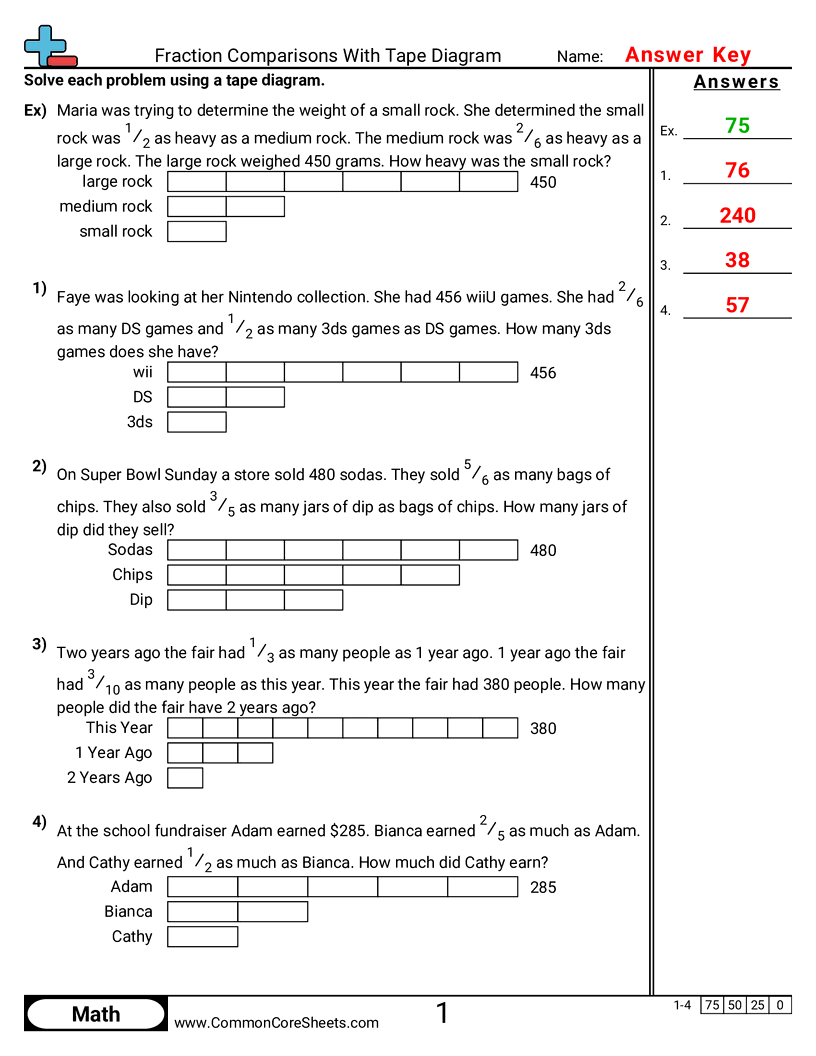
Each worksheet has 5 problems using a tape diagram to solve a problem.
Worksheet
One Atta Time
Flash Cards
Distance Learning
Create New Sheet
Customize Problems
Student Objectives
Use a tape diagram (bar model) to show what a fraction means as equal parts of a whole.
Compare two fractions by looking at the size of the shaded parts in the tape diagrams.
Tags
Word
visual
fractions
Standards
Playwire Advertisement